She says it
One enormous microphone. She holds it down and says anything — “a big town where everyone dresses up.” That sentence is the whole brief.
 Nothing to read
KidBuilder
Start For girls aged 4–9
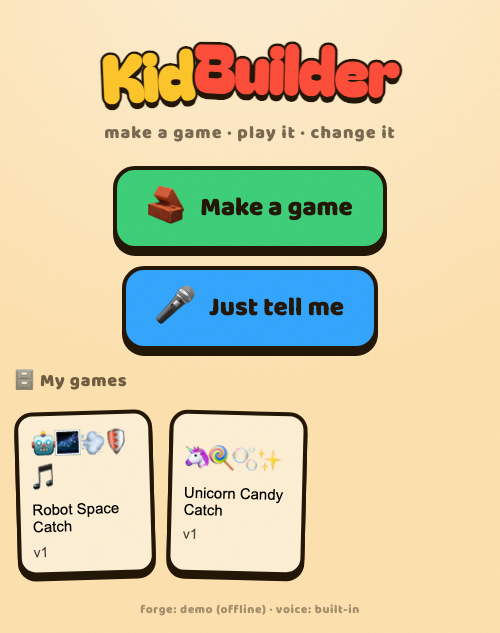
She says what she wants. Minutes later she's playing it — and she changes it just by talking.
No reading. No typing. No other players. Cancel any time.
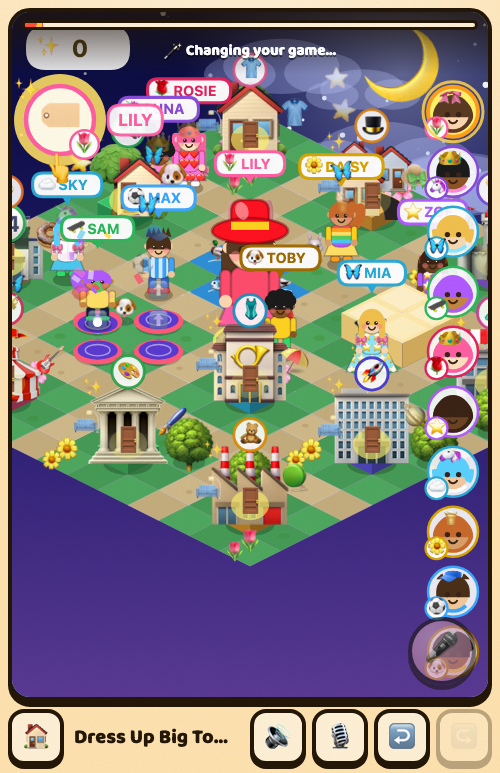
“I want a big town where everyone dresses up”
She's finished Toca Boca. She's decorated every room in Gacha Life, tried on every outfit in Roblox, fed the talking cat for the hundredth time. All of it built by someone else, for her to use up.
Nothing's wrong with those games. Something's wrong with that being all of it.
 Screen time that gets spent
 Screen time that builds something
One enormous microphone. She holds it down and says anything — “a big town where everyone dresses up.” That sentence is the whole brief.
Nothing to read
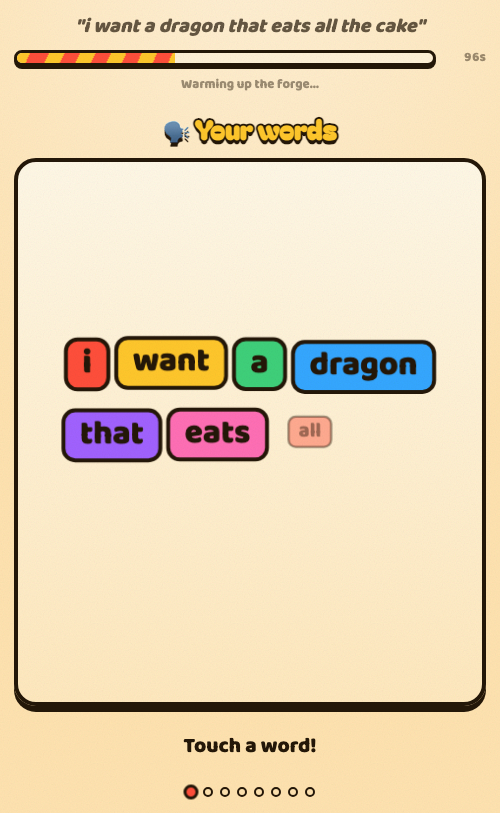
Building takes a few minutes — forever, when you're five. So the wait is a hands-on lesson about her game: the pixels her character is made of, the grid his world sits on, the rule that makes him collect things.
 Narrated out loud
The game fills the screen and the microphone stays right underneath. “Make it night time!” — and the sun goes down while she's still walking around. Every version is kept, so nothing she says can ruin it.
 Always undoable
Some days she arrives with the whole idea finished in her head. Other days she just wants to press something. Both work.
Tap a starting point and it reads itself out to her — then it stops being a template the moment she opens her mouth.
 A pet to look after
 A town to build
 A shop to run
 A creature to invent
 A world to explore
 A room to decorate
Her hero, her colours, her world — drawn for her game, not picked out of a clip-art drawer. That's what makes the possibilities actually infinite: there's no menu of options to run out of.
A dragon in a candy town. A penguin in an icy castle. A cat who runs a bakery on the moon. Whatever she says, that's what gets built.


There isn't one sentence in the app she has to get through. Every button says itself out loud, the lesson is narrated, and the only thing she ever does is talk.
Press these. This is exactly what she hears.
Same reason the speaker buttons are all over this page — so you can check it yourself before she ever touches it.
There is no one else in here. Not muted, not filtered, not moderated — absent.
 No other users
No chat, no friends list, no lobby, no usernames, no profiles. There is no mechanism by which another person can reach your daughter.
 No ads, nothing to buy
Nothing flashes at her, nothing asks her for gems, and no one is bidding on her attention. One price, that's it.
 Her games run in a locked box
Each game is sealed off — it can't reach the internet, can't store anything, can't touch the rest of the app. And every one is machine-checked before she sees it.
Her voice builds her game. Full stop.
It's used to make the thing she asked for and nothing else. Never sold, never used to advertise to her.
 Nothing to lose
No game over, no lives, no score going down. A mistake costs a funny wobble and play carries on — so she stays a builder instead of becoming a loser.
 You can see everything
Every game she's made sits on one shelf, in the open, with her own voice recording attached to it.
Unlimited games, one family. About the price of one boxed game she'd finish in a weekend.
Free for 7 days, then $29/month. Cancel any time, in one tap.
Works on any tablet or phone.
That's the whole design. There's one button on the home screen and it's a microphone. Nothing on screen has to be read, every label speaks itself, and the lesson is narrated. If she can say a sentence, she can make a game.
Yes, and specifically about her own game. While it builds, she colours in the pixels her character is made of, walks him around a grid and watches his two coordinates change, taps to speed up frames until motion turns smooth, and drags her hero into her goal to watch an if this, then that rule fire for real. Then she watches her game's actual code arrive, line by line.
A few minutes for a brand new one — which is why the wait is a lesson and not a spinner. Changes to a game she's already playing are much faster, and the game keeps playing while they happen.
She gets something. Whatever she says is taken seriously, garbles and all, and anything she left out is invented kindly. There is no wrong sentence and no error message — and if she doesn't like the result, she says what to change.
No. There is no chat, no lobby, no friends, no usernames — nothing for another person to arrive through. It isn't a moderated social space; it isn't a social space.
Anyone can use it. We built it because our daughters had run out of games to consume and had never once been offered the chance to make one.
Same hour of screen time. Very different child at the end of it.
Start building — $29/mo